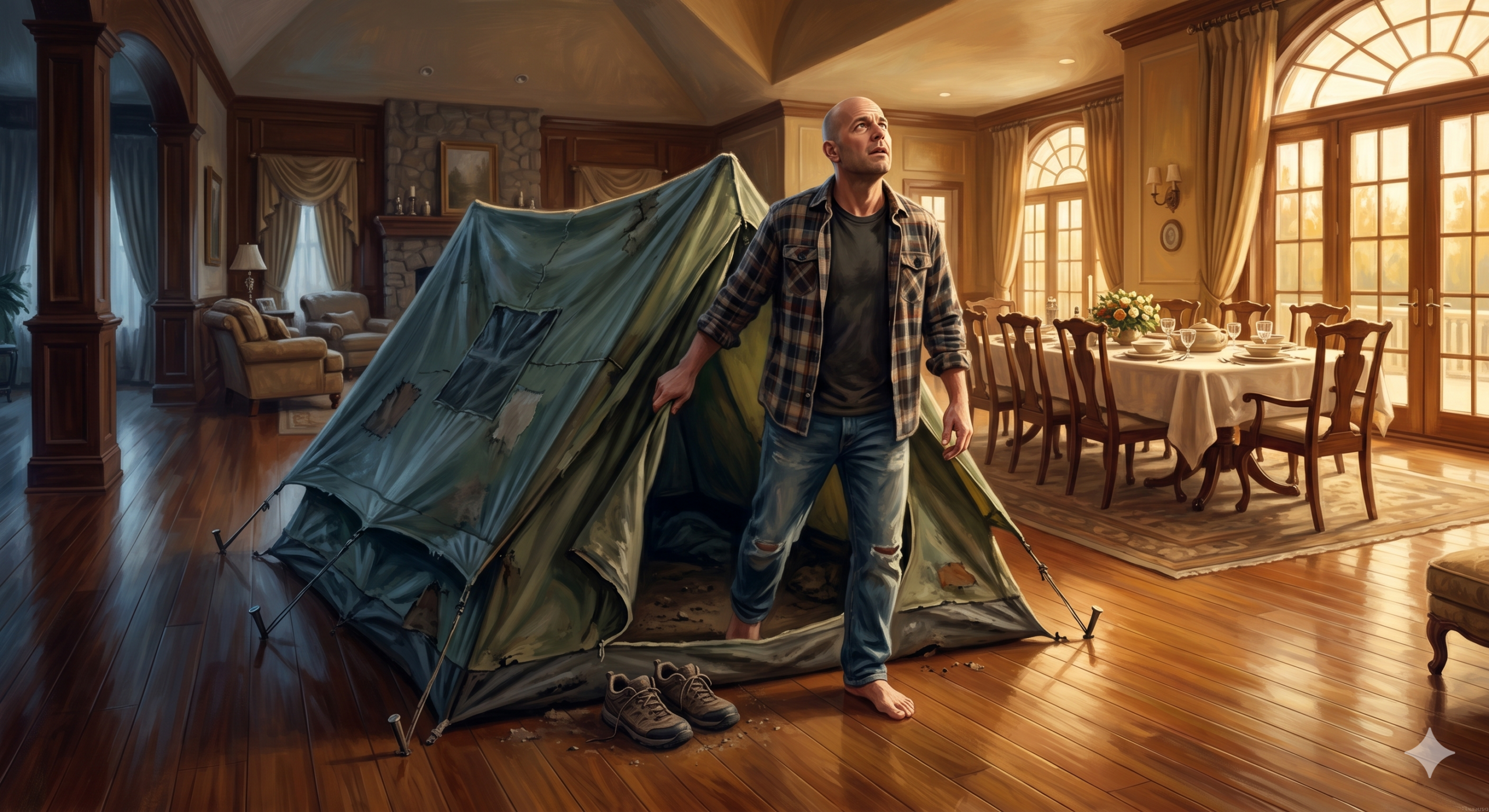
It is early morning. The cold is creaking on the roof of the houthuis. Fingers stiff, I let go of the keyboard and warm my hands against a cup of steaming boeretroos. The air is still, but my spirit has been stirring ever since a seemingly mundane moment yesterday at school—a moment that gripped my heart and refused to let go.
I never thought I would be doing this again, seeing as my own kids have grown to the point where they are starting to earn their own pocket money. During a session at school, a notorious busybody of a boy somehow got out of his shoe and could not get them back on again. I saw the laces were tied in knots like a yacht rope. So, I suggested he undo the shoe, put it back on, and redo it. His face fell when he explained that he did not know how to tie a shoe.
This all happened just after he had gotten very emotional because I called him out on behaviour that was not in line with the character of Jesus. I invited him over and offered to show him how I was taught to tie my laces. Cross the laces. Tuck the front lace behind the back lace and pull. Make one bunny ear with the other lace running around the bunny ear and into the hole behind. Catch the lace and pull. It took a while, but victory was like fireworks, and we each did our own happy dance.
But in that moment, I looked at this young boy from two different perspectives. First, as the notorious, mischievous terror, and secondly, as a beautifully created boy carrying all the potential and opportunity that we all have. In my line of work, guiding and counselling these kids, you see so much more than just the failures, mistakes, or lack. If you look closely enough, you see the heavy backpacks of brokenness they drag into the classroom every day. You see the self-inflicted scars. You see the deep, jagged cuts left by the careless words and actions of others around them.
I recently watched a message by a neurotheologian named Dr. Jim Wilder. What struck me before he even spoke was the humility of the moment—an older, wise man standing on stage, simply waiting as his friends carried out a chair for him to sit and teach from. He told a profound story about backpacking high up in the mountains, marvelling at the ancient trees near the tree line, when he heard the Lord whisper a strange thought to him:
“You’ve never seen a tree.” He looked around, confused. But the Lord continued: “The trees you’re looking at are nothing like the trees I created.” When we look at a tree, we see the lightning strike of 2018. We see the branches twisted by the harsh winds, or the bark stripped away by the elements. We see the damage. And when we look at each other—and especially when I look at the broken kids in my office—it is so easy to only see the storm damage.
But when Jesus looks at us, He doesn’t see the damage. He sees the original blueprint. He sees the breathtaking, eternal tree that He planted before time began, one that will flourish for thousands and thousands of years in His Kingdom.
For a long time in my own life, I operated from a place of wanting to be the one to fix the broken branches. I wanted to calculate the exact right advice, the perfect boundaries, the ultimate 5-step plan to heal them. But human logic is incapable of calculating the grace of God. Trying to fix someone in our own strength is like a toddler trying to shovel a Centurion hailstorm with a plastic spoon. Dr. Wilder beautifully likens our clumsy attempts at holiness to a two-year-old shoving snow in the wrong direction just to “help Daddy.” And you know what? The Father is absolutely delighted that we are just trying to be like Him.
The most humbling revelation of grace is realising that I have absolutely no idea what this boy is going to look like when he fully grows into the grace of God. I don’t know what his fully grown “tree” looks like. It is not my job to design it, and it is not my job to fix the broken branches. My job is much simpler, and much more profound.
Dr. Wilder points out a staggering truth about how God wired our brains: our identity centre is made entirely of mirror neurons. The only way a human being learns who they are is by looking at the faces of the people looking back at them. If I look at this young boy and only see his rebellion, his apathy, or his scars, he will believe that is all he is.
But what if I surrender my need to control his outcome? What if I choose to abide in the Vine (John 15), resting in the completed work of the cross, and simply let God’s face shine through mine?
If I look at him with the sheer delight, joy, and unmerited grace of the Father, those mirror neurons fire differently. Suddenly, looking into my eyes, he doesn’t see a “problem to be fixed.” He sees a beloved son of the King. He sees that there is a masterpiece buried beneath the mud, even if neither of us knows exactly what it looks like yet.
This is what it means to “take hold of that for which Christ Jesus took hold of me” (Philippians 3). It is the humility of letting go of my own agenda and actively choosing to be the greatest encourager of whatever beautiful, unseen thing God is growing inside the person in front of me.
So, my dear friend, here is my challenge to you today: When you encounter the broken, the hiding, and the hurting in your own life—whether you are helping them tie a shoelace or simply sharing a pancake and coffee—ask the Father to borrow His face. Smile at them with the joy of heaven. Choose to see the unseen tree.
May God’s peace and overwhelming shalom rest upon you today.
If this article is of value, please make a donation to support KleiTablette and Everlasting Way.